A Reference-to-Storyboard System for Short-Form Creative Teams
A short-form video can look effortless while hiding dozens of deliberate choices. The opening frame, the first spoken line, the moment a product appears, the order of proof, the speed of each cut, and the final call to action all shape whether a viewer keeps watching. When a team studies only the finished clip, those decisions collapse into a vague instruction: “Make something like this.”
That instruction is too loose for production and too close to imitation. A better system treats a reference video as evidence. The goal is to identify what the clip is doing, decide which parts are transferable, and convert the useful logic into an editable storyboard. This is the research-to-production loop behind a short-form creative workspace like ViralClip, but the method also works as a manual team process.

Why reference research often breaks down
Most weak reference briefs fail in one of three ways. Some describe only the surface: use the same song, a similar room, and fast cuts. Others jump straight to a script before understanding why the source clip works. A third group creates a long transcript but never connects the spoken words to the visual evidence on screen.
These approaches confuse assets with creative logic. A kitchen, a trending sound, or a specific presenter is an asset. A curiosity gap, a before-and-after demonstration, a timed objection, or a product proof beat is logic. Assets may need to change for a new brand or audience. Logic can often be adapted without copying the original expression.
A useful brief therefore needs two layers:
- Observable evidence: what is said, shown, heard, and timed in the reference.
- Transferable decisions: the hook, pacing, proof sequence, product role, creator role, and CTA logic that a new execution can reinterpret.
Pass one: capture what actually happens
Start with a time-based record, not an opinion. Capture the first frame, spoken lines, on-screen text, product appearances, camera changes, demonstrations, transitions, and CTA. The important unit is not merely the sentence. It is the relationship between a sentence and what the viewer sees while hearing it.
For dialogue-heavy references, a TikTok Transcript Generator can create the spoken timeline. The team should then annotate the transcript with visual actions. If the line says “I did not expect this to work,” note whether the creator is holding the product, showing a result, or delaying the reveal. Those visual details determine whether the sentence functions as a hook, proof, or transition.
For references where composition and movement matter more than dialogue, use Video to Prompt analysis to describe shots, subjects, camera motion, lighting, setting, and temporal changes. This converts an impression such as “cinematic product shot” into production language such as “tight push-in, shallow depth of field, centered package, warm side light, one-second hold before the hand enters.”
Research footage is rarely clean. Captions may hide important product details, and reposted footage can contain interface marks or watermarks. A video subtitle remover or video watermark remover can help a team inspect the underlying framing. Cleanup should support analysis and authorized reuse; it does not transfer rights to someone else’s footage.
Pass two: separate constants from variables
Once the evidence is visible, decide what must remain structurally true and what should change. This is the point where research becomes adaptation.
Constants are the functional relationships that give the idea its shape. A clip might open with a surprising outcome, delay the explanation for three seconds, show the product during the first proof moment, answer a likely objection, and close with a low-friction CTA. Those relationships can survive a new presenter, product, location, and script.
Variables are the elements that should respond to the new campaign. They include the creator persona, setting, product benefits, visual style, examples, claims, offer, audience vocabulary, and channel-specific ending. Treating them as editable variables protects the brand from becoming a costume placed on somebody else’s video.
A practical way to test the distinction is to ask: “If we replace this element, does the persuasive sequence still work?” If replacing the room has no effect, the room is probably a variable. If removing the visible demonstration makes the CTA feel unsupported, the demonstration is probably a structural constant.
Pass three: build an editable storyboard
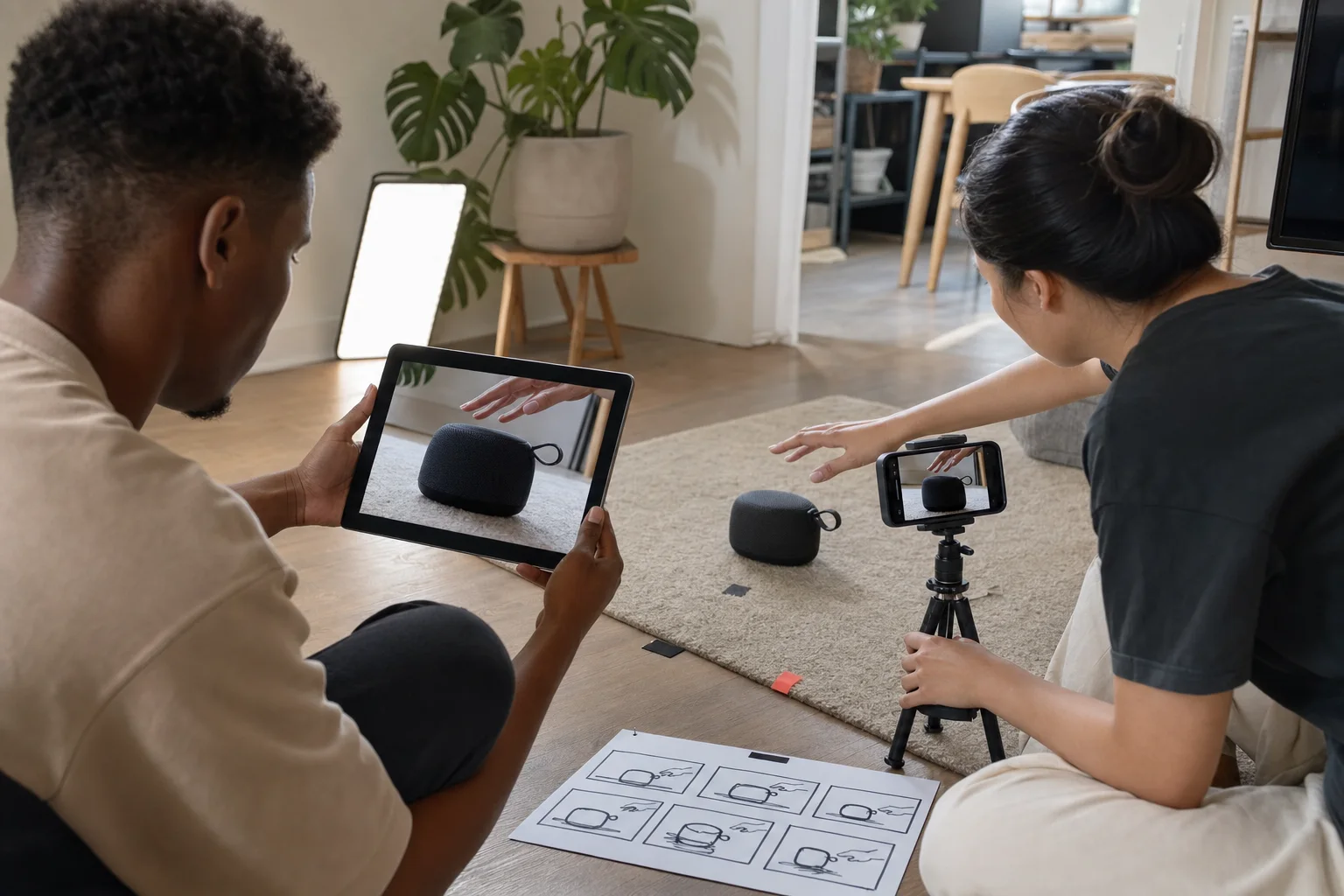
A storyboard should not be a frozen shot list. It should expose the decisions the team expects to revise. The Viral Video Cloner organizes adaptation around editable creative dimensions rather than treating the reference as a single prompt. A manual version can use the same principle.
For every scene, specify:
- Purpose: hook, context, proof, objection, payoff, or CTA.
- Visual evidence: what the viewer must be able to observe.
- Spoken role: the job of the line, not just its wording.
- Creator behavior: expression, gesture, eye line, and interaction with the product.
- Product state: where the product is, how it is held, and which details must stay accurate.
- Camera and motion: framing, angle, movement, and transition.
- Pacing: approximate duration and the event that earns the next cut.
- Brand constraints: claims, colors, tone, required disclosures, and prohibited depictions.
- Channel ending: the CTA and final frame needed for the intended placement.
This format is valuable because reviewers can disagree precisely. Instead of saying “the second half feels off,” a marketer can say the proof arrives too late, the creator gesture contradicts the voiceover, or the product state changes between shots.
Choose the production method by uncertainty
Not every scene should use the same generation workflow. Choose the method according to what must remain stable.
- Use text- or image-led video generation when the idea, environment, and camera behavior matter more than preserving a specific performance.
- Use AI Motion Control when a reference movement or gesture is the key creative constraint.
- Use AI Lip Sync when the performance is visually usable but the spoken message needs localization or a revised script.
- Use Text to Speech when the team needs controlled narration before committing to a final presenter recording.
- Use AI Product Photo for controlled pack shots, listing images, and visual proof assets that need a clearer product focus than a lifestyle scene can provide.
The principle is simple: preserve the input that carries the most risk. If package accuracy matters most, anchor the workflow with product imagery. If a gesture is the hook, preserve motion. If wording and timing are the variables, preserve the performance and change the speech layer.

Review the proof chain, not just visual polish
A polished clip can still fail if its argument is incomplete. Review the draft as a proof chain:
- Does the first frame create a specific question?
- Does the next beat add information instead of repeating the hook?
- Can the viewer see evidence for the main claim?
- Does the product appear at the moment it becomes relevant?
- Is the objection answered before the CTA?
- Would the story remain understandable with sound off?
- Does every cut have a reason: new evidence, a change in scale, or a change in emotional state?
This review should happen before a team generates many variants. Fixing a weak proof sequence once is cheaper and clearer than producing ten polished versions of the same structural problem.
Turn one reference into a testable family
The final output of reference research should not be one clone. It should be a controlled family of ideas. Keep the proof sequence stable while testing three hooks. Keep the hook stable while testing different demonstrations. Preserve the storyboard while changing creator persona, product angle, or CTA. Each family should change one meaningful variable at a time so performance feedback can teach the team something.
A disciplined loop looks like this:
- Decode the reference into observable evidence.
- Name the transferable creative logic.
- Separate structural constants from campaign variables.
- Convert the logic into an editable storyboard.
- Select production methods according to the highest-risk constraint.
- Review the proof chain before scaling variants.
- Publish controlled variations and feed results back into the next brief.
This approach makes reference-led creation more original, more reviewable, and more useful to a production team. The reference becomes a research input rather than a template, and the storyboard becomes the bridge between creative strategy and execution. Explore the full workflow in ViralClip.
Comments
Post a Comment